

TIG Welding and Fume Extraction: How the Process Works and Why Ventilation Matters
TIG (Tungsten Inert Gas) welding is a precise and versatile welding process used extensively for welding thin sections of stainless steel, aluminum, and other non-ferrous metals. It is valued for the high-quality, clean welds it produces with minimal spatter. Like all welding processes, TIG generates fumes and airborne contaminants that pose potential health risks to welders if not adequately managed.
How Does TIG Welding Work?
TIG welding (Tungsten Inert Gas welding) is a welding process that uses a non-consumable tungsten electrode to form a weld. Unlike MIG welding, the tungsten electrode does not melt into the weld. It maintains the arc while a separate filler rod is fed manually into the weld pool as needed. An inert shielding gas protects the weld area from atmospheric contamination.
TIG welding finds extensive application in welding thin sections of stainless steel, aluminum, and other non-ferrous metals, delivering high-quality, clean welds with minimal spatter. The process demands greater welder skill than MIG welding but produces superior weld quality on precision and appearance-critical applications.
What Fumes Does TIG Welding Produce?
Despite producing clean welds with minimal spatter, TIG welding generates fumes and airborne contaminants when the heat of the arc vaporizes the base metal, filler material, and any coatings or surface treatments on the workpiece.
Welding fumes can contain harmful substances including metal oxides, gases, and particulate matter. Stainless steel and aluminum welding produces the most toxic particulates found in harmful welding fumes because of hexavalent chromium and manganese. Harmful fumes and metals released during TIG welding include aluminum, chromium, iron, manganese, and nickel.
Long-term exposure to these substances has been associated with serious conditions including lung cancer, lifelong brain damage, and kidney failure. Because TIG welding is commonly used on stainless steel, a significant source of hexavalent chromium fumes, TIG welding environments carry a particularly elevated exposure risk without adequate fume extraction.
Why Is Fume Extraction Essential for TIG Welding?
Utilizing a TIG welding fume extractor is a critical aspect of ensuring a safe and healthy working environment for welders. Fume extraction shields the welder from inhaling hazardous substances and upholds the overall air quality in the welding environment.
Welding fumes can contain harmful substances like metal oxides, gases, and particulate matter, which can lead to respiratory problems, eye irritation, and more severe long-term health issues if not properly extracted. Inhaling welding fumes can lead to serious respiratory problems and other health issues that develop gradually over time.
Proper ventilation is also essential for compliance with occupational health and safety regulations and for establishing a comfortable and secure workplace. The choice of fume extraction system depends on the welding process, materials being welded, and the size of the work area.
How Does TIG Fume Extraction Work?
Source-capture fume extraction works by directly capturing and removing harmful welding fumes at their point of origin, through a nozzle or capture device positioned close to the emission source. This localized approach prevents the dispersion of harmful fumes and particles into the surrounding environment, promoting a safer and healthier workspace.
TIG fume extraction systems typically comprise a hood or capture device positioned near the welding arc to effectively collect fumes as they arise. The system then channels the extracted air through filters or other purification methods to eliminate harmful substances before reintroducing it into the workspace or expelling it outside.
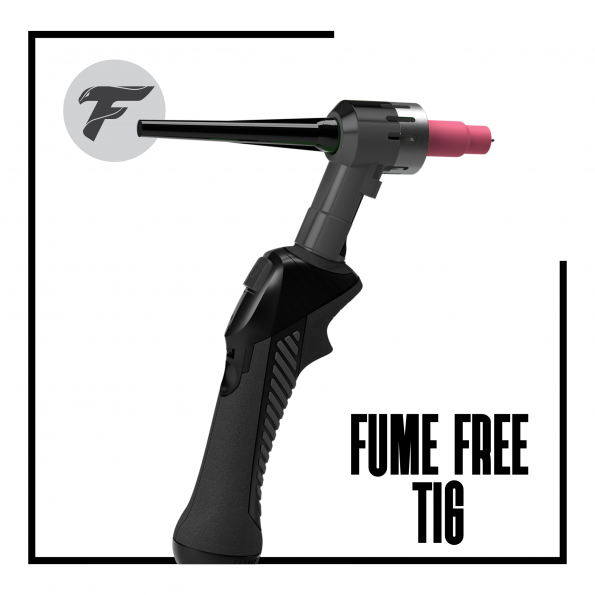
FumeFree’s 8TE TIG Fume Extractor Gun is a source-capture system that integrates extraction directly into the welding torch. Used with the ClearO2 T100 or T200 portable extraction unit, the 8TE delivers up to 95% extraction of welding harmful particulate directly at the source.
Types of Fume Extraction Systems for TIG Welding
Selecting the right fume extraction system depends on the welding application, materials, and workshop layout. There are several types of TIG fume extraction systems available:
Torch-Integrated Extractors (Source-Capture):
These extractors are connected directly to the welding torch, capturing fumes right at the source. The capture point moves with the torch, eliminating gaps in coverage as the welder changes position. FumeFree’s 8TE TIG Fume Extractor Gun is an example of this type.
Portable Extractors:
Mobile units that can be moved around the workshop. Well suited to smaller welding shops, individual welding stations, or situations where the welder’s position changes frequently. The ClearO2 T100 and T200 are portable extraction units purpose-built to work with the 8TE.
Stationary Extraction Arms:
Fixed arms installed above or beside welding tables. The arm is pulled close to the weld zone during welding, then repositioned as needed. Effective when consistently positioned but require the operator to adjust the arm with each new work position.
Frequently Asked Questions
What is TIG welding?
TIG (Tungsten Inert Gas) welding is a welding process that uses a non-consumable tungsten electrode to form a weld. The electrode maintains the arc while filler material is added manually as needed. An inert shielding gas protects the weld from atmospheric contamination. TIG welding is widely used on stainless steel, aluminum, and other non-ferrous metals for applications requiring high-quality, precise welds.
Why does TIG welding require fume extraction?
Although TIG welding produces clean welds with minimal spatter, the process generates fumes and airborne contaminants that pose potential health risks if not adequately managed. These fumes can contain metal oxides, gases, and particulate matter, including hexavalent chromium and manganese, that can lead to serious long-term health issues. Fume extraction captures these hazardous substances before they can be inhaled.
What hazardous substances does TIG welding produce?
TIG welding releases harmful fumes and metals depending on the base metal and filler material. Stainless steel and aluminum welding produces the most toxic particulates because of hexavalent chromium and manganese. Other hazardous metals released during TIG welding include aluminum, chromium, iron, manganese, and nickel. Long-term exposure to these substances has been associated with lung cancer, lifelong brain damage, and kidney failure.
What is source-capture TIG fume extraction?
Source-capture fume extraction is a method of welding ventilation that captures fumes directly at their point of origin, through a nozzle or capture device positioned close to the welding arc, before they can disperse into the surrounding workspace. It is the most effective approach to TIG fume extraction because it removes harmful particulates before they enter the welder’s breathing zone.
How much fume can a TIG fume extractor capture?
FumeFree’s 8TE TIG Fume Extractor Gun, when used with the ClearO2 T100 or T200 portable extraction unit, delivers up to 95% extraction of welding harmful particulate directly at the source.
What metals can be welded with TIG?
TIG welding finds extensive application on stainless steel, aluminum, and other non-ferrous metals. It is particularly well suited to thin sections and applications requiring high-quality, appearance-critical welds.
Is TIG welding fume extraction different from MIG fume extraction?
The principle of source-capture extraction is the same, capturing fumes at the arc before they disperse. The equipment differs: TIG welding uses a non-consumable electrode and a different torch geometry, so TIG fume extraction torches such as the 8TE are designed specifically for TIG applications. MIG welding uses a consumable wire electrode, and FumeFree’s 8XE is the equivalent source-capture solution for MIG welding